A complex number
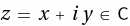 (where
 ) is plotted in the Argand plane with real component x along the horizontal axis and imaginary component y along the vertical axis.
Consider a complex function
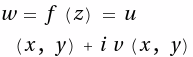 . Because a full Cartesian plot of
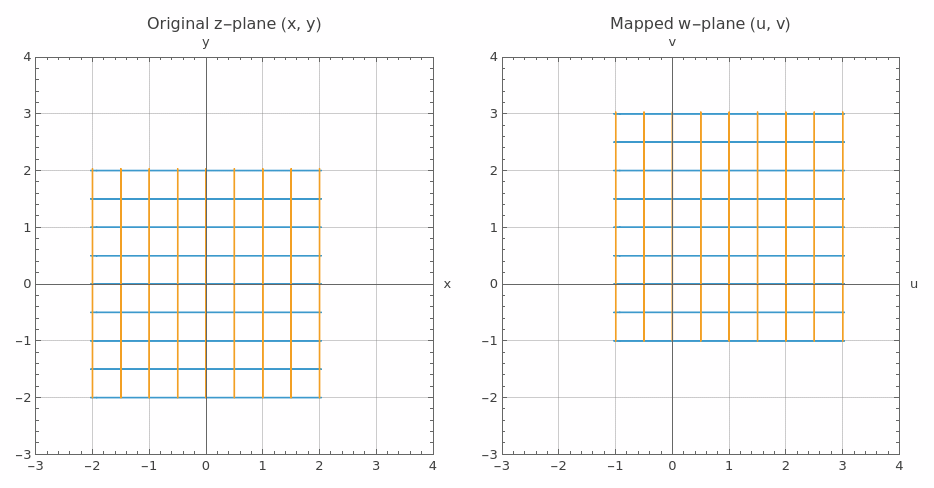
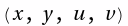 requires four real dimensions, we visualize f as a geometric mapping from the domain z-plane to the target w-plane.
Let
 . Expanding in rectangular coordinates:
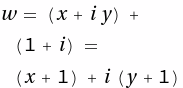 (1.1)
Equating real and imaginary components gives:
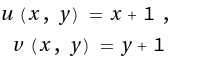 (1.2)
Computing the complex derivative:
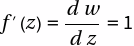 (1.3)
Since f(z) is analytic and
 , f is a conformal mapping that preserves both the magnitude and orientation of angles between intersecting curves. In this specific case, the action is a rigid translation of the coordinate grid by the vector (1, 1).
The following script can be run in Wolfram’s Mathematica to plot the transformation f domain and codomain.